
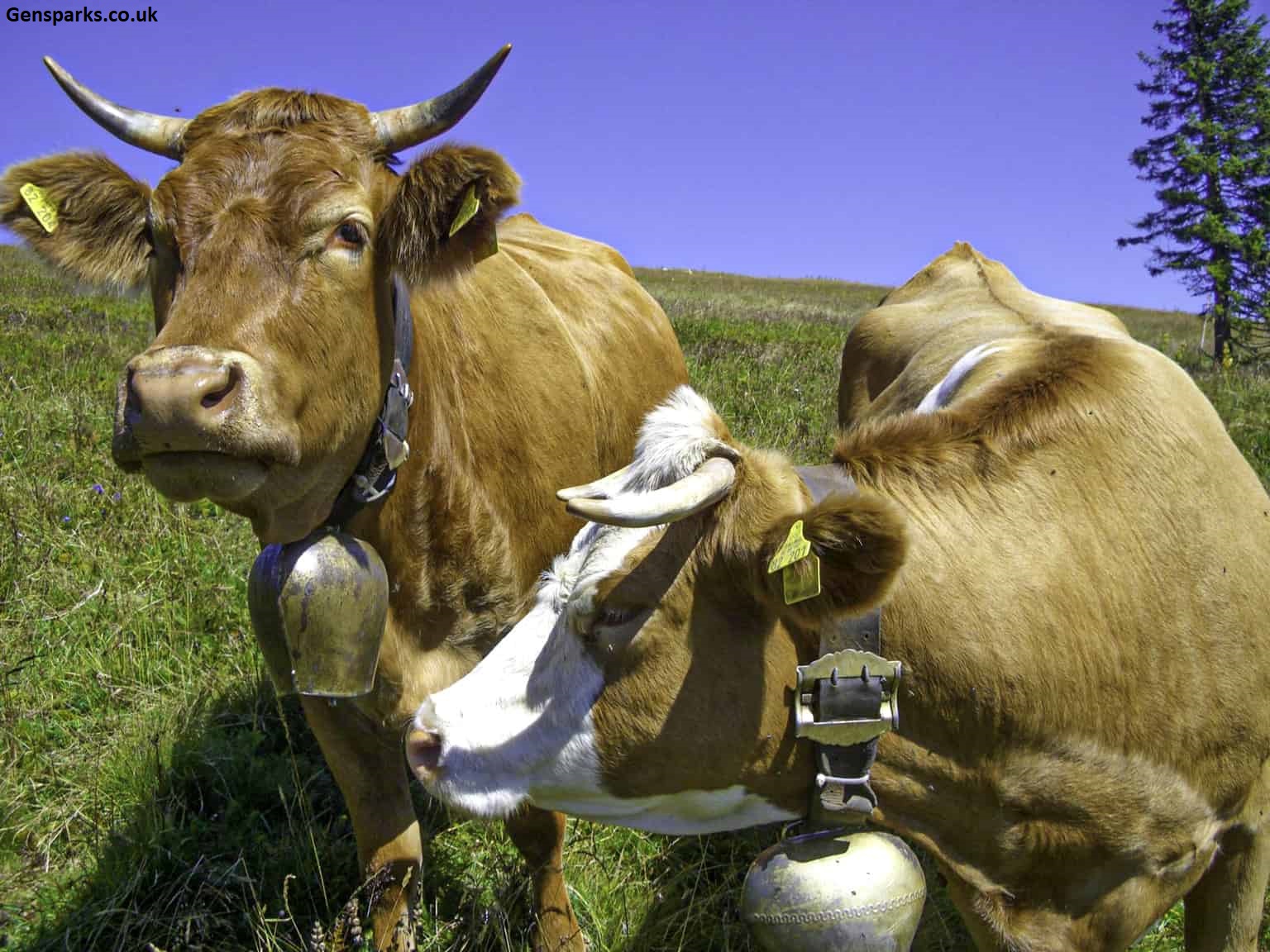

Why Do Cows Wear Bells? Cows wear bells primarily so that farmers and herders can locate and track their animals across large, open pastures, dense forests, or mountainous terrain where visual monitoring is difficult or impossible.
The sound of a bell carries far greater distances than sight alone, making it an incredibly practical tool for livestock management.
Bells also help farmers quickly identify if an animal has wandered too far, become separated, or stopped moving, which could signal injury or illness.
In alpine regions like Switzerland and Austria, cow bells carry deep cultural and traditional significance, symbolizing good luck, rural heritage, and the arrival of seasonal grazing seasons.
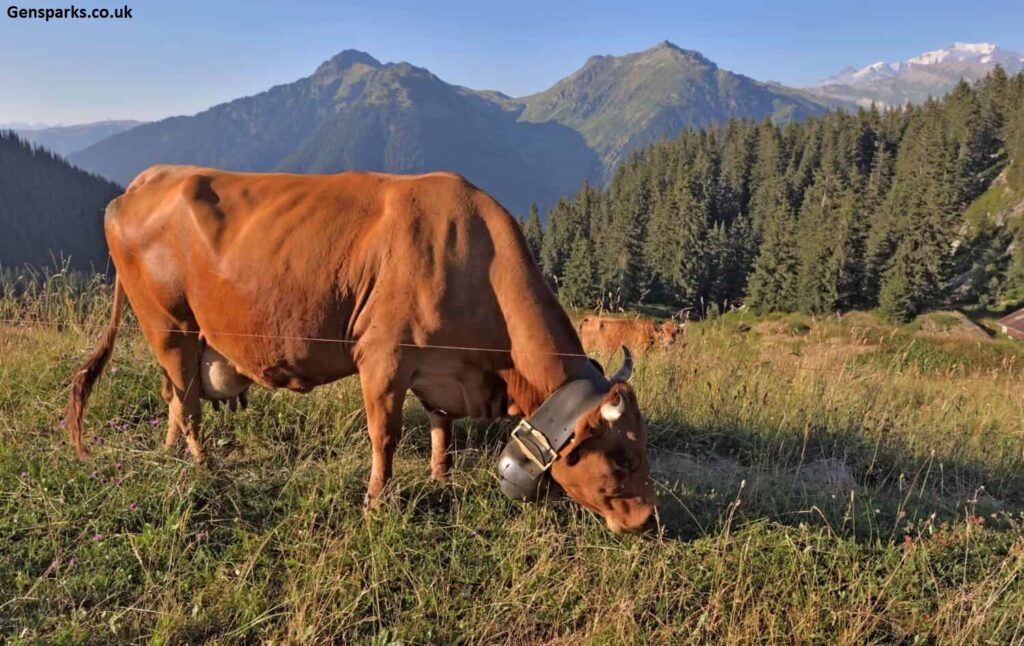
The first time I heard a cowbell up close, I was hiking through a meadow in the Swiss Alps, completely caught off guard.
A big, calm Brown Swiss cow just ambled out of the treeline, and that deep, resonant clang echoed off the hillside. I froze. The cow looked at me like I was the strange one. Fair enough.
Table of Contents
Quick Table
| Reason | Details |
|---|---|
| Tracking Location | Helps farmers locate cows across large pastures and dense terrain |
| Detecting Separation | Alerts farmers when a cow has wandered too far from the herd |
| Identifying Illness | Silence or stillness of a bell may signal injury or sickness |
| Herd Management | Easier to monitor and gather large herds efficiently |
| Alpine Tradition | Deep cultural significance in Switzerland, Austria, and Italy |
| Good Luck Symbol | Bells are believed to ward off evil spirits and bring good fortune |
| Seasonal Grazing | Marks the beginning and end of mountain grazing seasons |
| Lead Cow Identification | Largest bell worn by the lead cow to guide the rest of the herd |
| Tourism and Heritage | Cow bells attract tourists and represent rural cultural identity |
| Predator Awareness | Bell sound may deter or alert farmers to predator activity nearby |
Why Do Cows Wear Bells?
Cows wear bells primarily so that farmers and herders can locate and track their animals across large, open pastures, dense forests, or mountainous terrain where visual monitoring is difficult or impossible.
The sound of a bell carries far greater distances than sight alone, making it an incredibly practical tool for livestock management.
Bells also help farmers quickly identify if an animal has wandered too far, become separated, or stopped moving, which could signal injury or illness.
In alpine regions like Switzerland and Austria, cow bells carry deep cultural and traditional significance, symbolizing good luck, rural heritage, and the arrival of seasonal grazing seasons.
It Started as a Practical Problem
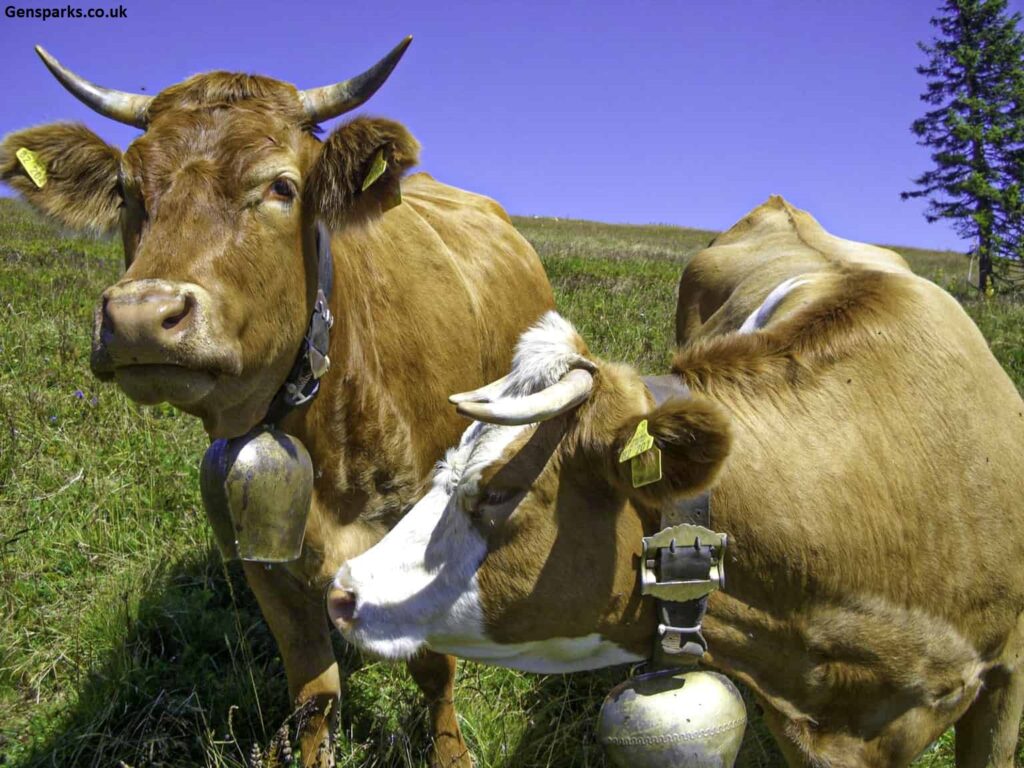
Before GPS and electric fencing, farmers had a very real challenge: cows graze freely, and they wander. Pastures in mountainous or heavily forested regions can stretch for hundreds of acres.
Lose track of a cow in the Swiss Alps or the Appalachian highlands, and you could spend an entire afternoon searching.
The bell solved this before anyone thought to call it a “solution.” If you can hear the cow, you know roughly where it is.
The bell jingles when the animal moves — grazing, walking, tossing its head — and goes quiet when the animal is resting.
That silence, actually, is a signal. Farmers told me that if a cow’s bell goes quiet for too long, it often means the animal has stopped moving — which could mean it’s resting normally, or it could mean something’s wrong.
Stuck in a ditch, injured, or separated from the herd. The bell is an early warning system disguised as a decoration.
Quick fact
Traditional cowbells are still hand-forged by small craftspeople in Switzerland, Austria, and parts of Germany. They’re sized based on the animal — larger cows get heavier, deeper-toned bells.
A single well-made bell can last the lifetime of several cows.
The Herd Dynamics Angle — This One Surprised Me
One Vermont dairy farmer, Doug, who’s been running a 60-cow operation for over 20 years, explained something I hadn’t considered: bells also help manage herd behavior.
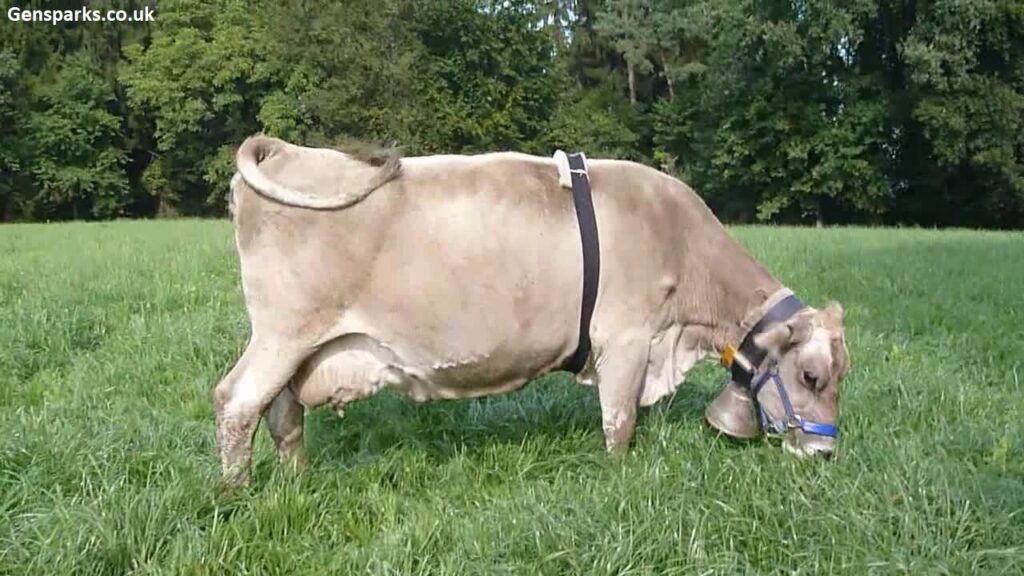
Cows are deeply social. They follow each other. In a large pasture, you might give the bell to the lead cow — the dominant female, often called the “boss cow” — and the rest of the herd naturally stays close to her.
One bell, one cow, and you’ve got a rough GPS on the entire group.
Doug told me he used to lose hours searching for straggling cows until he started doing this. Now, he listens for the bell from his porch at dusk. If it’s close, the herd is coming home.
If it’s distant, they’re still out.
“The bell tells me more than any app would. I know where they are, I know how fast they’re moving, and I know if something’s off — all from the sound.”
Why Different Cows Get Different Bells
Here’s something I didn’t know until I started paying attention: not every bell sounds the same, and that’s intentional.
In traditional Alpine farming, experienced farmers can identify individual cows by their bell tone.
Different cows in the same herd are given bells of different pitches and sizes, so a farmer listening from a distance can actually count their animals and know which ones are where. It’s acoustic bookkeeping.
The bells come in distinct sizes — from small, high-pitched ones for younger calves, to large, low, cathedral-like bells worn by matriarch cows.
In Switzerland, there are even specific regional bell styles that differ in shape, tone, and ornamentation based on the canton they come from.
Sizes & tones at a glance
- Small bells (Treichel) — worn by younger or smaller animals, higher pitch, lighter weight
- Medium bells (Glocken) — general-use herd bells for mid-size cows, versatile tone
- Large bells (Trycheln) — worn by dominant or lead cows, deep resonant tone, often ceremonial
The Alpine Tradition Is Still Alive
Every autumn in the Swiss and Austrian Alps, there’s a ceremony called the Alpabzug (or “descent from the alps”).
Cows that spent the summer grazing on high mountain pastures are brought back down to the valley before winter sets in. They’re decorated with flowers, garlands, and their finest, most ornate bells.
It’s not just quaint tradition. It’s a public celebration of the farming season.
The bells signal to the village that the herd made it through the summer healthy. Larger herds with more decorated cows signal a prosperous farm.
I watched a version of this in a small Austrian village in 2022, and honestly? It was genuinely moving.
The sound of 80 cows coming down a narrow mountain road, bells resonating against stone buildings, is something you feel in your chest.
Do Cows Mind Wearing Them?
This is the question I get asked most when I bring this topic up, and it’s a fair one. A cowbell can weigh anywhere from a couple of ounces to several pounds. That’s not nothing around an animal’s neck all day.
The research on this is more nuanced than a simple yes or no.
A 2015 study from ETH Zurich found that cows wearing large, heavy bells (the ceremonial kind) spent less time lying down and less time ruminating compared to cows without bells — both of which are indicators of lower rest quality.
The noise and weight at close range appeared to mildly stress the animals.
However, most working farm bells are much smaller and lighter than the large ceremonial ones used in the study.
The everyday bells used for tracking purposes are generally low enough in weight that most farmers and veterinarians consider them acceptable for animal welfare when fitted correctly.
The key things farmers watch for:
- The bell collar should fit properly — not too tight, not loose enough to chafe
- Bells should not be worn 24/7 if avoidable (many farmers remove them at night in the barn)
- Heavy ceremonial bells should only be worn for events, not daily use
- Watch for signs of irritation or behavior changes in newly belled animals
Modern Farming and GPS — Are Bells Going Away?
You’d think GPS ear tags and smart collars would have killed the cowbell by now. And honestly, for larger industrial operations, they largely have.
Technology like Allflex GPS collars, HerdDogg ear tags, and various Bluetooth-based livestock trackers do what bells do and more — they track exact coordinates, monitor body temperature, detect lameness through gait analysis, and send alerts to your phone.
But here’s the thing: small-scale and traditional farmers aren’t abandoning bells anytime soon. And it’s not just sentiment.
Bells don’t need charging. They don’t have a monthly subscription fee. They don’t fail in poor cell coverage areas (which describes most remote mountain pastures).
A good handmade cowbell outlasts most consumer electronics by decades. For a family farm with 20 cows in a hilly region with spotty signal, a $30 bell is often more reliable than a $200 tech tracker.
When tech beats bells
Large operations with 500+ cattle, feed lots, or automated milking systems benefit far more from smart collars and RFID systems.
These can track individual animals’ milk production, detect heat cycles, and flag illness — things no bell can do. It’s not either/or; it’s about scale and context.
FAQ’s
Do cow bells bother the cows wearing them?
Studies have shown that heavy bells can slightly affect feeding and sleeping behavior in cows. However, lighter modern bells are designed to minimize discomfort while still serving their practical tracking purpose effectively.
How far can a cow bell sound travel?
Depending on terrain, wind conditions, and bell size, a cow bell sound can travel anywhere from several hundred meters to over a kilometer, making them highly effective across large open landscapes.
Are cow bells still used today or just traditional?
Both. While modern farmers increasingly use GPS tracking technology, cow bells remain widely used across alpine regions and rural farming communities worldwide for their simplicity, reliability, and zero technology dependence.
Why do some cows wear larger bells than others?
The largest and loudest bell is traditionally worn by the lead cow, also known as the herd queen. Other cows naturally follow her, making her bell the most important navigational tool within the herd.
Do other animals wear bells besides cows?
Yes. Goats, sheep, horses, and even cats wear bells for similar tracking and safety reasons. In many cultures, bells on animals also carry spiritual and protective symbolic meaning.
Conclusion
The simple cow bell is far more than a rustic decoration or charming countryside accessory.
It represents centuries of practical wisdom passed down through generations of farmers, herders, and rural communities who understood the very real challenges of managing livestock across vast and unforgiving landscapes.
Long before GPS satellites and digital tracking systems existed, a bell was the most reliable tool a farmer had to keep his herd safe, together, and accounted for at all times.
Beyond pure practicality, the cow bell carries a rich cultural weight that continues to resonate deeply, particularly across alpine nations like Switzerland and Austria where it symbolizes heritage, seasonal tradition, and a profound connection to the land.
The ceremonial parades marking the return of cattle from mountain pastures each autumn remain celebrated community events that draw visitors from around the world.
Today, even as modern technology offers sophisticated alternatives, the cow bell endures.
Its simplicity is its greatest strength — requiring no battery, no signal, and no maintenance beyond a basic clasp around a willing bovine neck.
Whether heard echoing across a misty Swiss valley or a quiet countryside farm, the sound of a cow bell remains one of the most peaceful and timeless sounds in the natural world.